


How to Remove Glue on Leather Sofa
- ashbourneleathercare

- Jul 3
- 6 min read
How to Remove Glue on Leather Sofa. A blob of adhesive on a leather suite can go from minor annoyance to obvious eyesore very quickly. If you have glue on leather sofa surfaces, the biggest mistake is rushing in with the wrong cleaner, too much force, or a sharp tool. Leather is durable, but its finish is far easier to damage than most people realise.
The good news is that glue does not always mean permanent damage. In many cases, the mark can be reduced or removed. Where the adhesive has affected the colour or finish, a proper repair can usually restore the area so it blends back in with the rest of the sofa. The right approach depends on the type of glue, how long it has been there, and what kind of leather you are dealing with.
What makes glue on leather sofa surfaces tricky
Glue sits differently on leather than it does on hard surfaces such as glass or timber. On a finished leather sofa, there is usually a coloured and sealed topcoat. That topcoat gives the leather its look, its sheen, and much of its stain resistance. If you scrub too hard or use a harsh solvent, you may remove more than the glue - you may lift the colour or strip the finish.
That is why a home fix can sometimes turn a localised spot into a much larger repair. A small patch of dried glue is one issue. A patch of missing colour, dulled finish, or roughened leather is another.
It also matters whether the glue is sitting on the surface or has bonded into a crack, seam, or worn area. Older sofas with faded arms or thinning finish are more vulnerable than newer leather in good condition.
First, do not make these common mistakes
The urge to pick, peel, scrape, or soak the area is understandable, but it often creates the real damage. Fingernails can scratch the finish. Knives and metal blades can cut into the leather coating. Baby wipes, household sprays, acetone, and strong solvents can smear the glue while also breaking down the protective finish.
Heat can be risky too. Hairdryers and steam may soften some glues, but they can also dry the leather, alter the sheen, or make the adhesive spread further. If the sofa is pigmented leather, which most household leather furniture is, the colour layer can be surprisingly easy to disturb.
A simple rule helps here: if the method sounds aggressive, it probably is.
How to assess the glue before you touch it
Before trying to remove anything, take a proper look at the area in good light. Is the glue clear, white, yellow, or rubbery? Is it a small droplet, a smeared patch, or a hardened crust? Does it sit on top of the leather, or does it appear embedded into a crack or grain line?
Fresh craft glue, super glue, contact adhesive, and hot glue all behave differently. Fresh white glue may still be soft and easier to lift carefully. Super glue is more likely to bond firmly and leave a shiny, hardened patch. Contact adhesive often smears and can discolour the finish. Hot glue may peel slightly, but it can still tug at the topcoat underneath.
You should also check whether the leather itself already looks worn, faded, scratched, or dry around the mark. If it does, the safest option is usually professional treatment rather than home removal.
A cautious approach to glue on leather sofa areas
How to Remove Glue on Leather Sofa. If the glue is very small and appears to be sitting on the surface, the safest starting point is patience. Let fresh glue dry fully if it is still wet and mobile. Trying to wipe wet adhesive usually spreads it across a wider area.
Once dry, test whether the edge can be eased very gently with your fingertip or a soft cloth wrapped around your nail. The aim is not to peel aggressively. You are only checking whether the glue has formed a raised skin that can lift without resistance. If it does not move easily, stop.
A slightly damp soft cloth with plain water may help with some water-based glues, but the cloth should never be wet enough to soak the leather. Dab rather than rub. If any colour transfers to the cloth, stop immediately. That tells you the finish is being affected.
For anything stronger than a light surface spot, household experimentation becomes far less predictable. What works on one sofa can permanently mark another.
When glue removal turns into colour repair
This is the point many homeowners do not expect. Sometimes the glue itself can be removed, but the leather underneath no longer matches. You may be left with a dull patch, a shiny patch, lifted colour, a roughened spot, or a visible ring where the finish has changed.
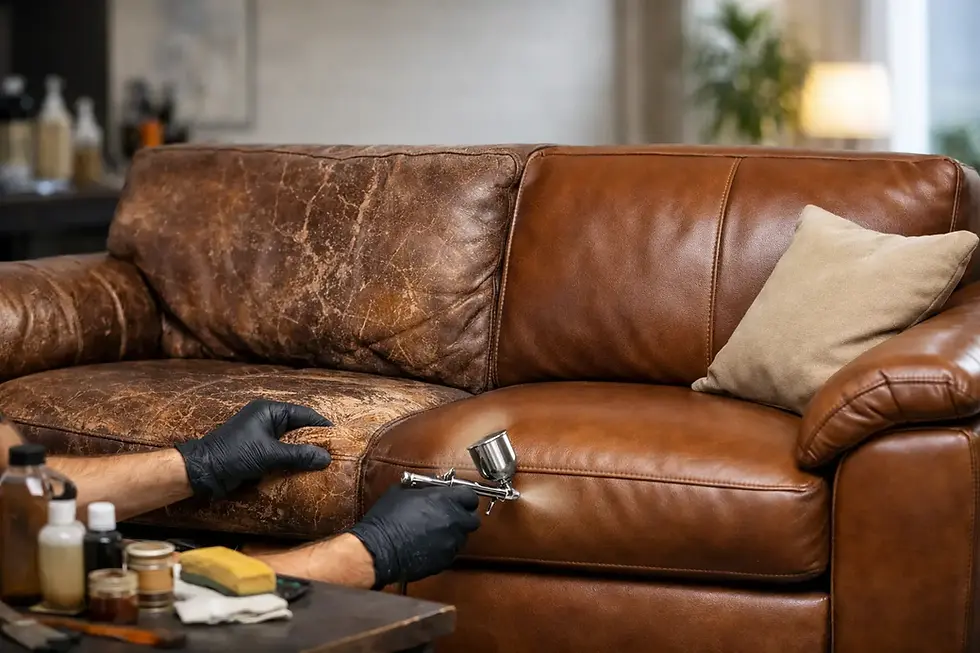
That is why proper leather restoration is often about more than removing the adhesive. It can involve surface preparation, blending the damaged area, restoring the colour, and reapplying a suitable finish so the repaired section looks natural again.
On a sofa arm, seat cushion, or front panel, appearance matters just as much as stain removal. A technically clean patch that still catches the eye is not a finished result.
Why professional treatment is often the better option
Leather furniture is expensive to replace and easy to damage with trial-and-error cleaning. A specialist will assess the type of adhesive, the condition of the leather, and whether the issue is surface contamination, finish damage, or both. That matters because the solution should match the problem.
In many cases, a professional repair can treat the glue mark and restore the affected finish on site. That means no struggling with internet remedies, no guessing which product is safe, and no making the damage larger than it needs to be. For homeowners in Dublin, Meath, Kildare, and Louth, this kind of practical service is often the quickest route back to a sofa that looks right again.
At Ashbourne Leather Care, this is exactly the kind of accidental damage we are called out to repair. Glue marks, colour disturbance, surface scuffs, and finish loss can often be restored without the upheaval of replacing the furniture.
Can every glue mark be removed completely?
Sometimes yes, sometimes no - and the honest answer depends on the extent of the damage. If the adhesive is sitting on top of an intact finish, the chances are usually better. If it has bonded into a damaged, cracked, or worn area, a perfect removal may not be realistic without repair work.
There are also situations where the glue has caused staining or changed the surface texture. In those cases, removal alone will not solve the visual problem. The leather may need recolouring or refinishing to bring it back to a consistent appearance.
What matters most is not whether the glue can be lifted in one piece. It is whether the sofa can be returned to a clean, even, presentable finish.
What to do next if you have glue on leather sofa upholstery
If the mark is small, recent, and clearly superficial, a very cautious attempt with a soft cloth and minimal moisture may be reasonable. Beyond that, restraint usually saves money. The more products and methods you try, the more variables you introduce, and the harder the final repair can become.
A clear photo in daylight is often enough for a specialist to judge what is likely going on. Close-up images, along with a wider shot of the panel or cushion, help show whether the problem is localised or tied to wider wear. If you know what type of glue was involved, that is useful too.
The key thing is to act early, but not recklessly. Fresh damage is often easier to treat than damage that has been scrubbed, smeared, or coated in several cleaning products.
Protecting the rest of the leather after an adhesive accident
Even if the glue mark is only in one spot, it is worth thinking about the surrounding leather. Sofas that have had one visible accident often also show the early signs of everyday wear - faded headrests, scuffed arms, dryness on seat fronts, or small scratches from clothing, pets, or daily use.
When one area is repaired properly, it often highlights how much better the whole piece could look with targeted restoration. That does not always mean a full refurbishment. Sometimes a local repair and colour blend is enough. In other cases, a broader refresh gives a more balanced result.
If your leather sofa still has good structure and comfort, restoration is usually the sensible option. It keeps a quality piece in use, avoids the cost of replacement, and restores the appearance of the room without major disruption.
Glue accidents feel frustrating because they happen suddenly and look stubborn. But they are not always the end of the story. With the right treatment, even a sofa marked by adhesive can often be brought back to a finish you are happy to live with again.



Comments