


What Affects the Cost of Leather Sofa Restoration?
- ashbourneleathercare

- Jul 10
- 6 min read
What Affects the Cost of Leather Sofa Restoration? A leather sofa rarely wears out all at once. More often, it starts with a faded headrest, a cracked seat cushion, a scuff on the arm, or a stain that never quite lifts. When that happens, the first question most homeowners ask is simple - what is the cost of leather sofa restoration, and is it worth it compared with replacing the sofa altogether?
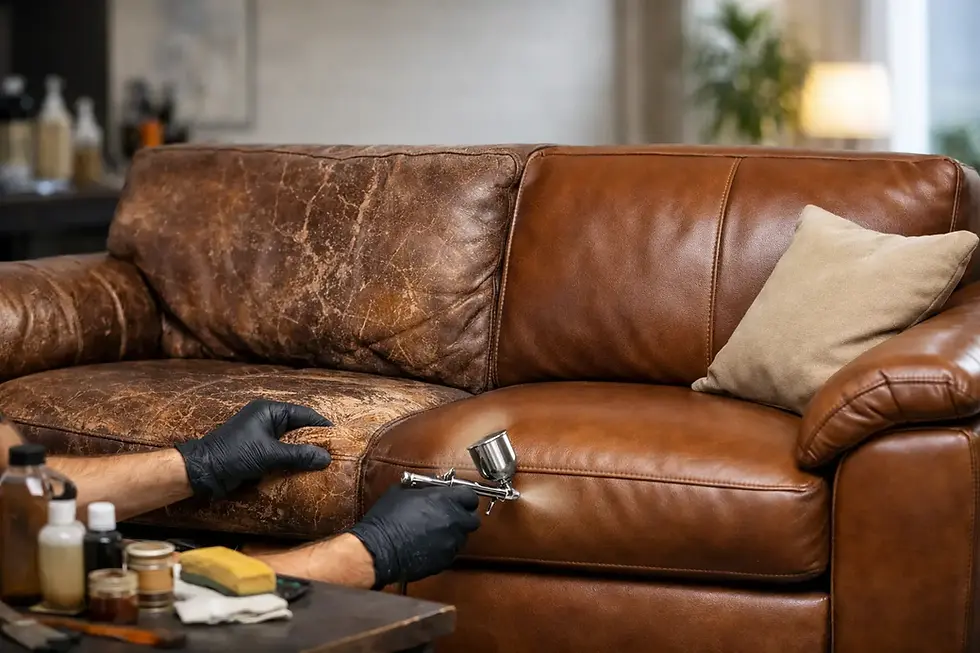
The honest answer is that it depends on the condition of the leather, the type of damage, and how much work is needed to restore the finish properly. A small localised repair will cost far less than a full refurbishment of a well-used suite, but in many cases restoration is still the more practical and cost-effective option. If the frame is sound and the sofa is comfortable, bringing the leather back to life often makes far more sense than shopping for a new replacement.
What affects the cost of leather sofa restoration?
The biggest factor is the extent of the damage. A sofa with light surface wear and mild fading is a very different job from one with peeling colour, deep cracking, ink marks, bleach damage, acetone, or several affected panels. Restoration work is priced around the time, materials, and skill required to get a durable result, not just to cover the damage for a few weeks.
Leather type also matters. Some finishes are straightforward to clean, repair and recolour, while others need a more careful matching process to restore the original look. If a sofa has a specific tone, sheen, or grain pattern, extra work may be needed to blend the repaired area naturally with the surrounding leather.
The size of the furniture will also influence price. A two-seater with one damaged cushion is clearly a smaller job than a corner sofa with wear across multiple seating areas. The more surface area involved, the more preparation, colour work and finishing time is required.
Small repairs versus full restoration
Not every sofa needs a complete overhaul. In many homes, the damage is concentrated in the spots that get the most daily use - seat cushions, arm fronts, headrests and piping. If the rest of the sofa is still in good condition, a targeted repair can be enough to improve the appearance significantly.
This is why quotations are usually based on photos first. A clear set of images helps identify whether the problem is localised or whether the whole piece would benefit from a wider refurbishment. For example, one patch of lost colour from a cleaning accident may be handled as a single repair, while general fading across the full suite may need a more complete colour restoration.
There is a cost difference between cosmetic improvement and full restoration too. A quick surface tidy-up is not the same as properly preparing the leather, repairing damaged areas, restoring colour, and finishing it so it looks right and holds up under normal use. Good restoration work takes more care, but it also gives a better and longer-lasting result.
Common problems that change the price
Some types of damage are simpler to deal with than others. General wear, dullness, mild scuffs and faded areas are often more straightforward than accidental damage caused by household products. Ink, bleach, glue and nail polish can all behave differently on leather, and each needs its own repair approach.
Bleach is a good example. It does not just sit on the surface - it can strip colour from the leather entirely. That means the work is not only about cleaning the area. It may involve rebuilding the appearance of the damaged section, matching the surrounding tone, and restoring the finish so the repaired spot does not stand out.
Cracking is another issue that affects cost. Light cracking can sometimes be treated and improved very effectively, but heavy cracking or worn-through areas may require more involved repair work before any colour restoration can begin. The same applies to scratches and scuffs. A faint surface mark is one thing; deeper damage that has broken the finish is another.
Why on-site service matters to the overall value
Price is only part of the decision. Convenience matters as well, especially with bulky furniture that is awkward to move and expensive to transport. One of the clear benefits of professional leather sofa restoration is having the work carried out on site, without the disruption of removing the sofa from your home.
For many homeowners, that changes the value equation. There is no need to arrange disposal of the old sofa, wait for a new one to arrive, or deal with the hassle of getting large furniture through doors and hallways. If the sofa is a good quality piece and the damage is mainly to the leather finish, restoration can save time as well as money.
That is particularly true for homes in Dublin, Meath, Kildare and Louth, where a mobile service makes the whole process much easier. You send photos, receive a quotation, and the work is carried out at your premises. It is a straightforward solution for a problem that often looks worse than it really is.
Is restoration cheaper than replacement?
Very often, yes - but not always in the same way. If you compare restoration with buying a low-cost sofa, the numbers may appear closer. But that is not always a fair comparison. Many leather sofas that are worth restoring were originally better made, more comfortable, and more durable than what is commonly available at entry-level prices now.
So the better question is this: what would it cost to replace your current sofa with something of similar quality? Once homeowners look at that figure, professional restoration usually starts to look far more appealing.
There is also the question of appearance. A well-restored leather sofa keeps the furniture you already know fits the room, suits the house and feels comfortable to use. You are not starting again and hoping a replacement matches in the same way. You are improving what you already have.
When the cost of leather sofa restoration is worth paying
Restoration tends to be worthwhile when the structure of the sofa is still good and the main issue is the condition of the leather surface. If the cushions are supportive, the frame is solid, and the damage is visual rather than structural, repair and recolouring can make a major difference.
It is especially worth considering when the damage is embarrassing but localised. A single bleach mark, a patch of cat scratches, heavy fading on one seat, or a nail polish accident can make the whole sofa look tired. Yet the actual repair area may be limited. In those cases, restoration can be a smart way to improve the furniture without paying for a full replacement.
The value is also stronger when the sofa has sentimental or practical value. Some pieces simply suit a room better than anything new. Others are part of a larger matching set, which makes replacement more awkward and expensive. Restoring the existing leather often keeps the room looking consistent without unnecessary cost.
Getting an accurate quotation
Because so much depends on the type and severity of damage, the most reliable way to understand cost is to request a quotation based on photos. Clear images of the full sofa and close-ups of the damaged areas help a specialist assess what is needed and whether the problem can be treated as a repair, a refurbishment, or a more extensive restoration.
Good photos save time and set expectations properly. They also help identify whether a colour match is likely to be simple or more involved, and whether there are several issues affecting the same area. That matters because a faded seat with cracking and staining is not priced in the same way as a seat with fading alone.
Ashbourne Leather Care works this way for a reason. It gives homeowners a practical starting point and helps them understand the likely scope of the job before booking anything in.
The cheapest option is not always the best value
When comparing prices, it is worth being careful about what is actually included. Proper leather restoration is not just a quick wipe-over or a surface recolour. Good results depend on preparation, suitable repair methods, accurate colour work and a finish that looks natural and lasts under normal household use.
A lower price may sound attractive, but if the repair is rushed or the colour match is poor, the sofa can end up looking patched rather than restored. In the long run, that is not good value. Homeowners usually want the repair to blend in, wear well, and let them keep enjoying the furniture without the damaged area drawing the eye every time they enter the room.
If you are weighing up the cost of leather sofa restoration, think beyond the first number. Look at the condition of your sofa, the quality of the piece, and how much useful life a professional repair could give it. Very often, the right restoration work is the difference between replacing a sofa too soon and enjoying it for years to come.
If your leather sofa is faded, stained, scuffed or marked by an accident, a quote based on clear photos is the quickest way to find out what is possible - and you may be pleasantly surprised by how much can be restored.


Comments