


What Is the Best Leather Furniture Restorer?
- ashbourneleathercare

- Jul 1
- 6 min read
A leather sofa rarely wears out all at once. More often, it starts with a faded headrest, a shiny arm, a scuff on the front panel, or a stain that will not lift no matter how careful you are. When that happens, it is natural to ask what is the best leather furniture restorer - a product you can buy, a DIY kit, or a professional service that comes to your home.
The honest answer is that the best restorer depends on the problem in front of you. Leather is not one single material with one single finish, and the wrong approach can make a small issue look worse. A good result comes from matching the treatment to the damage, not simply picking the most expensive bottle on the shelf.
What is the best leather furniture restorer for your sofa?
If your sofa is simply looking tired, the best leather furniture restorer may be a high-quality cleaner and conditioner used correctly. If the leather has lost colour, suffered scuffs, or picked up damage from ink, bleach, glue or nail polish, a basic restorer will not be enough. In those cases, what works best is targeted repair followed by colour and finish restoration.
That distinction matters. Many homeowners use the word restore when they really mean clean, nourish, recolour or repair. These are different jobs. A product that freshens the surface will not fix colour loss, and a conditioner will not remove a bleach mark.
The problem with off-the-shelf leather restorers
Shop-bought leather restorer products can help in mild cases, but they are often treated as a cure-all. They are not. Some are little more than cleaner with added oils. Others add temporary sheen that makes leather look better for a short time, without dealing with the real wear underneath.
This is where disappointment usually starts. A sofa with rubbed colour on the seat cushions may look dry, but dryness is not always the issue. On many modern leather suites, the visible problem is damage to the finish and colour coat rather than a lack of moisture. Applying more cream or balm can leave the area patchy, sticky or uneven in sheen.
There is also the risk of using a product that is wrong for the leather type. Aniline, semi-aniline and pigmented leathers all behave differently. What suits one can darken, mark or over-soften another. If you are not sure what finish you have, caution is better than guesswork.
When a DIY kit is enough
There are situations where a DIY leather restorer can be a sensible option. Light surface dirt, mild dullness and very small scuffs on low-visibility areas can sometimes be improved at home. If the leather is structurally sound and the damage is superficial, careful cleaning and a modest touch-up may do the job.
That said, DIY works best when expectations are realistic. It is suitable for improving appearance, not for delivering an invisible repair on a prominent sofa in the middle of your sitting room. The more visible the damage, the more skill matters.
Colour matching is usually the point where home kits fall short. Even a slight mismatch stands out on a large panel, especially in daylight. The same goes for sheen. If one cushion has a flatter finish than the rest, the repair can draw the eye instead of disappearing into the furniture.
When the best restorer is a professional service
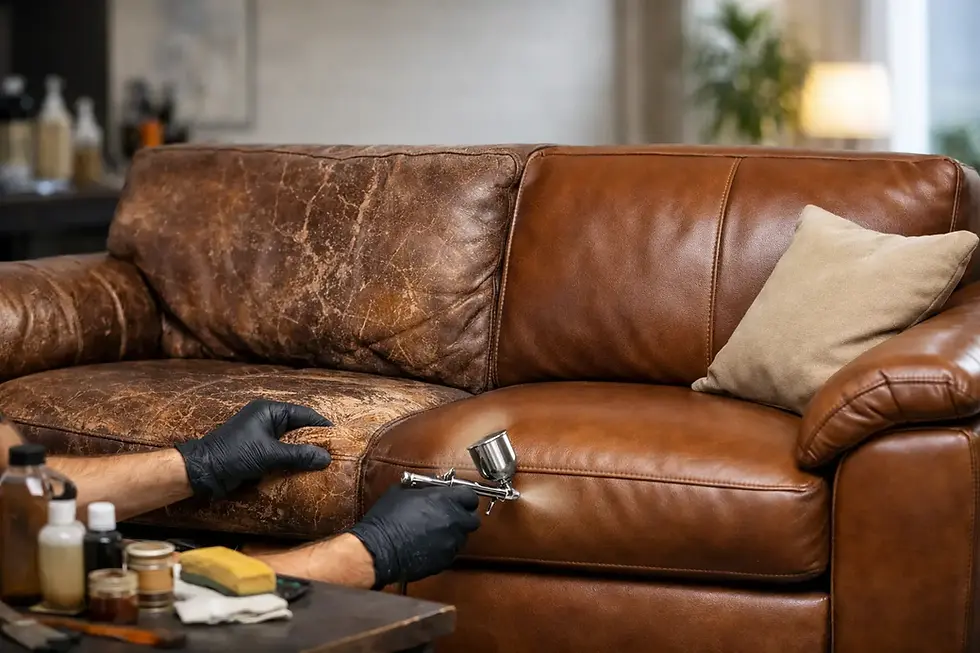
If your leather furniture has fading, worn areas, scratches, stains that have set in, or accidental household damage, the best leather furniture restorer is usually not a product at all. It is a specialist who can assess the leather, prepare the damaged area properly, carry out repairs where needed, and restore the colour and finish to suit the rest of the piece.
This is particularly true for the problems homeowners worry about most - ink marks, bleach spots, nail polish, glue, heavy scuffs, cracked finish and obvious colour loss on arms, seats and headrests. These are not cleaning issues. They are repair and refurbishment issues.
A proper restoration service does more than cover the mark. It deals with the cause and the surface condition underneath. That might involve removing contamination, smoothing damaged areas, rebuilding the surface where required, restoring lost colour and applying a finish that matches the original look as closely as possible.
For many households, this is the point where replacement starts to seem like the only answer. In reality, a professional restoration can often bring a good-quality sofa back to life at far less cost and disruption than buying new.
What a good leather restoration service should offer
A specialist service should make the process straightforward. You should be able to show the damage, get clear guidance on whether it is repairable, and understand what result to expect. That matters just as much as the repair itself.
Look for a provider that focuses specifically on leather furniture rather than general cleaning. Leather repair is a niche skill. The techniques used for carpets, fabric upholstery or car valeting do not automatically transfer to a leather sofa in a family home.
It also helps if the service is carried out on site. Large furniture is awkward to move, and many homeowners do not want the hassle of removing a suite from the house for assessment or repair. A mobile service that works at your premises is often the most practical option, especially when the issue is localised to one panel or one seating area.
An experienced specialist will also be honest about limits. Not every piece will return to factory-new condition, and not every stain can be made fully invisible. But many problems that look severe to the owner can be improved dramatically when treated properly.
Signs your furniture needs restoration, not just cleaning
If you are unsure whether you need a leather restorer or a full repair service, the visual clues are usually clear once you know what to look for.
If the sofa feels grimy or looks dull all over, cleaning may be the first step. If one area is lighter than the rest, rough to the touch, cracked in the topcoat, or shiny from wear, restoration is more likely. The same applies if there is a specific spill or accident that has changed the colour of the leather.
Bleach stains are a classic example. People often try to clean them, but there is nothing to clean away - the colour has been removed. Ink can soak in and bond with the finish. Glue and nail polish can alter the surface itself. These issues need targeted treatment, not just a wipe-down.
Cost, convenience and the replacement question
Most people asking what is the best leather furniture restorer are also asking a second question quietly in the background - is this worth saving?
In many cases, yes. Good leather furniture is expensive to replace, and newer alternatives do not always match the quality of the original piece. If the frame and padding are still sound, restoring worn leather can be a very sensible decision.
There is also the convenience factor. Replacing a sofa means shopping, measuring, waiting for delivery and getting rid of the old one. Restoration is usually faster and far less disruptive. For households in Dublin, Meath, Kildare and Louth, a mobile specialist service can take much of the hassle out of the process by assessing the damage from photos first and carrying out the work in your home.
That practical approach is a big part of why many homeowners choose professional help. It turns a frustrating problem into a clear next step.
So, what is the best leather furniture restorer?
The best leather furniture restorer is the option that matches the damage properly. For light maintenance, a good cleaner and conditioner may be enough. For visible wear, colour loss, scuffs, stains and accidental damage, the best results usually come from specialist leather restoration carried out by someone who understands finishes, repairs and colour work.
If your sofa is valuable, prominent in the room, or damaged in a way that stands out every time you walk past it, it is worth treating it as a repair job rather than a quick DIY experiment. A careful professional can often restore beauty, colour and finish in a way that feels far closer to the original.
At Ashbourne Leather Care, that is exactly the kind of work we do every day - practical, on-site leather restoration that saves good furniture from being written off too soon.
If your leather furniture is faded, stained or worn, the best next step is not guessing which bottle might work. It is getting an expert view on what can be restored and how good it can look again.


Comments