


Leather Colour Repair Cream Review for Sofas
- ashbourneleathercare

- Jul 12
- 6 min read
Updated: Jul 17
Leather Colour Repair Cream Review for Sofas. A faded armrest can make an otherwise good leather sofa look far more tired than it really is. That is why a leather colour repair cream review can be useful - but only if it separates minor cosmetic touch-ups from the deeper repairs that need a specialist finish. The right product may improve a small scuff or light colour loss. Used on the wrong problem, it can leave a patchy, sticky or noticeably mismatched area.
For many homeowners, the question is not whether a cream is cheap or easy to buy. It is whether it will make the sofa look better from across the room and still look right after normal family use. That depends on the leather type, the extent of the damage and how accurately the colour and finish can be matched.
What leather colour repair creams are designed to do
Leather Colour Repair Cream Review for Sofas. Most leather colour repair creams are intended to refresh worn surface colour. They are commonly used on pale scuffs, faded cushion edges, worn seat areas and light marks where the protective finish has thinned but the leather beneath is still sound. Some are closer to a coloured balm, while others are pigmented creams designed to deposit colour into the worn area.
At their best, these products can reduce the contrast between a small damaged patch and the surrounding leather. On a dark brown or black sofa with a slight rub mark, that may be enough to make the damage much less distracting. They are usually straightforward to apply with a cloth, sponge or applicator pad, and they can be a sensible short-term option for a very minor flaw.
However, cream is not a complete leather restoration system. It will not rebuild missing leather, properly disguise a deep scrape, remove a strong ink stain or reverse bleach damage. It also cannot reliably correct cracking, peeling coatings or a sofa that has faded unevenly over several large panels.
Leather colour repair cream review: the honest verdict
A fair leather colour repair cream review comes down to expectation. For a small, low-traffic scuff where the colour match is close, a quality cream can offer a visible improvement. It is most likely to work when the existing finish is still largely intact and the repair area is no bigger than a coin or two.
The trade-off is durability and consistency. A cream sits at or near the surface, so repeated friction from clothing, pets, children and regular seating can wear it away. Armrests, seat fronts and favourite cushions receive the most use, which means they are also the places where a quick cream repair is least likely to last.
Colour matching is the other challenge. Leather does not simply come in ‘brown’, ‘grey’ or ‘cream’. A sofa may have warm undertones, darker grain, a soft sheen or a slightly aged patina that has developed over years. Even a product sold as the correct shade can appear too flat, too red, too dark or too glossy once it dries.
That does not make repair creams useless. It means they work best as a controlled touch-up rather than a cure-all. If you can accept a modest improvement rather than an invisible repair, they may be worth trying on a discreet area first.
Why some DIY repairs look worse after drying
The most common problem is applying too much product too quickly. A heavy layer can fill the natural texture of the leather and dry with a hard-edged patch. On smooth leather, that patch may catch the light differently from the rest of the sofa, making the repair more visible than the original scuff.
Preparation matters too. Everyday furniture carries body oils, polish residue, dust and cleaning-product build-up. If colour cream is applied over contamination, it may not bond evenly. The result can be streaking, poor coverage or colour that transfers onto clothing.
Sheen is often overlooked. Many leather sofas have a satin or low-gloss finish rather than a shiny one. A coloured cream may restore the shade but leave the area duller or glossier than the surrounding panel. Professional restoration normally considers the colour, the feel and the final finish together, rather than treating them as separate issues.
There is also the risk of confusing leather types. Pigmented leather is common in family sofas and often responds well to professional recolouring. Aniline and semi-aniline leather are more absorbent and can mark differently. Faux leather, bonded leather and peeling synthetic coatings need a different approach altogether. Applying a generic cream without knowing the material can create an uneven surface or make later repair more difficult.
When a repair cream can be a sensible choice
A DIY cream is most suited to a tiny surface scuff, a faint rub mark or a very localised area of colour loss on genuine leather. It can also be useful where the sofa is older, the damage is minor and a perfect finish is not essential.
Before using any product, test it on an inconspicuous section such as the rear edge or underneath a cushion. Clean the test spot gently, use a very small amount and allow it to dry fully. Check the colour in daylight as well as under your room lighting. A shade that seems right in the evening can look surprisingly different beside a window.
Use thin layers rather than trying to cover the mark in one pass. Avoid aggressive rubbing, especially on worn leather, as friction can remove more of the original finish. If the product darkens the area, turns tacky or creates a clear outline, stop rather than adding further layers.
When to leave the job to a leather repair specialist
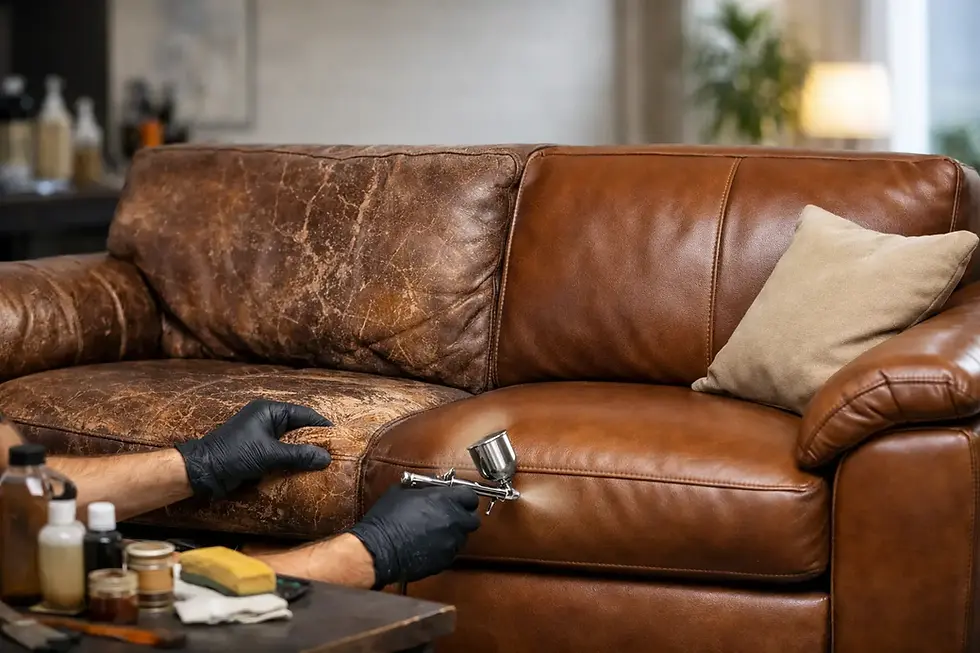
Professional restoration is generally the better choice where the damage is obvious, the affected area is large or the sofa is a valued piece of furniture. This includes faded headrests and armrests, bleach spots, ink marks, nail polish, glue, deep scratches, pet damage and areas where the finish has worn through.
A specialist can assess whether the issue is colour loss, a stain, damaged coating or actual surface damage. That distinction matters. A bleach mark, for example, may need careful preparation and colour rebuilding. An ink mark needs controlled stain treatment before colour work begins. Covering either with a cream may hide the issue briefly but can leave it visible underneath.
For larger faded areas, the repair needs to blend into adjacent panels rather than stop at the edge of the damage. The colour may need to be mixed specifically for the sofa, then applied in fine coats and finished to match the original level of sheen. This is how a repair becomes part of the furniture rather than an obvious patch.
There is a practical benefit too. A mobile service allows restoration to be carried out in your home, without the inconvenience of moving a heavy sofa or being without it for weeks. For homeowners in Dublin, Meath, Kildare and Louth, Ashbourne Leather Care can assess photos of the damage and provide a clear quotation before arranging an on-site repair.
The cost question: cream versus restoration
A repair cream costs less upfront, which makes it tempting for any visible mark. But the cheapest option is not always the most economical. If several attempts leave colour build-up, uneven gloss or staining around the repair, the area may require extra preparation before it can be restored properly.
Professional work costs more because it involves diagnosis, surface preparation, colour matching and finishing, not simply applying colour. For a premium leather sofa that is structurally sound, restoration can still be considerably better value than replacement. It preserves a piece that already fits your room, feels familiar and may have years of use left.
The decision often comes down to scale. A tiny mark on a less visible section may justify a careful DIY touch-up. A prominent armrest, seat cushion or pale leather sofa usually deserves a more precise repair.
A better way to judge the damage
Look at the sofa in natural daylight and ask three simple questions. Is the damage confined to the colour, or is the leather scratched, cracked or torn? Is it in a high-use area? Would a slightly imperfect patch still bother you every time you sit down?
If the answer points to a small, hidden and superficial mark, a leather colour repair cream may be a reasonable first step. If the damage is central, spreading or caused by a household accident, clear photographs and specialist advice will give you a more dependable route back to a clean, even finish.
Your sofa does not need to be beyond use before it deserves attention. Dealing with colour loss and accidental damage early can protect the leather’s appearance, keep a good piece of furniture in your home and bring back the finish you enjoyed when you first chose it.


Comments